


Neighborhood Watch vs. Professional Patrol: What Actually Keeps a Neighborhood Safe?
When a neighborhood gets rattled—a string of car break-ins, a daytime burglary, package thieves working the block—the response follows a familiar script. The group chat lights up. Someone proposes a neighborhood watch. Someone else asks about hiring security patrols. And then the conversation stalls on the real question: what actually works?
It's worth answering carefully, because both approaches have genuine value, genuine limits, and—as the safest neighborhoods have figured out—a natural way of working together. Here's the honest comparison.
What Neighborhood Watch Actually Does Well
A neighborhood watch, at its core, is organized awareness: neighbors agreeing to pay attention, communicate, and report. Done well, it delivers real benefits:
Eyes that know what normal looks like. Nobody can spot the out-of-place car, the stranger testing door handles, or the unusual activity at the vacant house better than the people who see the street every day. Resident awareness is genuinely superior local intelligence—no professional can match its coverage or context.
Communication infrastructure. Watch groups, neighborhood apps, and group chats spread warnings fast: the package thief spotted on one street is known to the whole neighborhood in minutes.
Community cohesion. Neighborhoods that organize around safety know each other better, watch out for each other's homes during travel, and present the connected, attentive face that opportunists prefer to avoid.
Police liaison. Established watch programs often build relationships with local departments, improving reporting quality and getting the neighborhood's concerns onto the department's radar.
Where Neighborhood Watch Hits Its Limits
The limits are structural, and being honest about them prevents disappointment:
Observation is not response. Watch programs are explicitly watch and report—and correctly so. Residents confronting suspicious individuals or crimes in progress create exactly the dangerous situations every police department warns against. So the model's ceiling is: see something, call, and wait—with response times determined by police availability, not neighborhood urgency.
Coverage follows enthusiasm—then fades. Watch programs run on volunteer energy, which surges after incidents and ebbs with normal life. Vacation seasons, work schedules, and simple fatigue produce gaps—usually largest overnight, exactly when property crime concentrates.
No training, no accountability, no documentation. Volunteers aren't trained in de-escalation, legal boundaries, or incident assessment, and no one is accountable for coverage. What gets seen, and what gets missed, is luck.
Deterrence is diffuse. Signs and stickers help modestly, but seasoned offenders read the difference between a sign and a presence.
What Professional Patrols Add
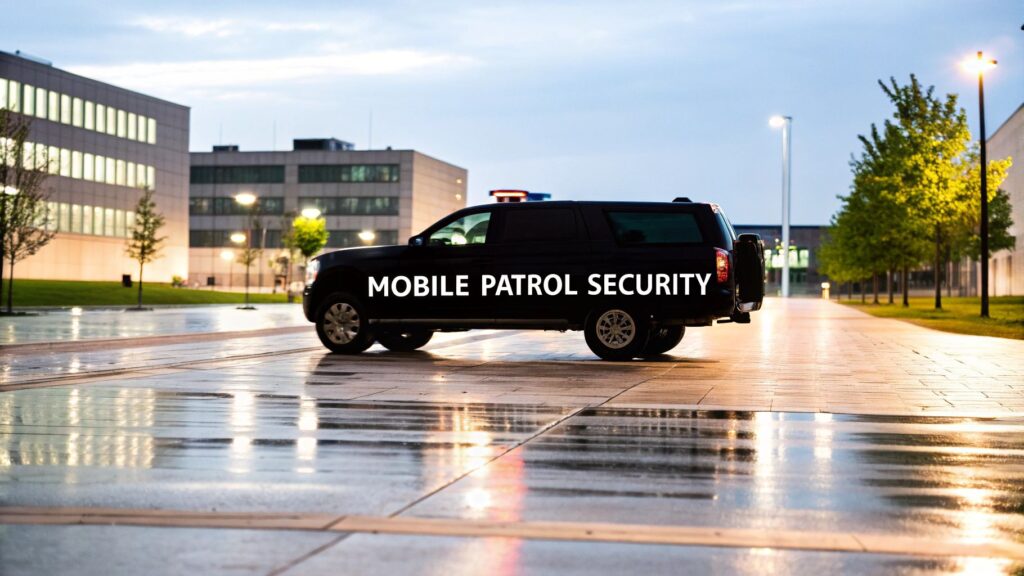
Professional neighborhood patrol services—typically funded by an HOA, or by neighbors pooling subscriptions—put trained security officers in marked vehicles into the neighborhood on randomized schedules. The additions are exactly the watch model's gaps:
Presence with response capability. A patrol officer doesn't just observe the suspicious activity—they can approach, engage, document, and coordinate with police as trained professionals, lawfully and safely. The watch's "see and wait" becomes "see and act."
Reliable, scheduled coverage—including at 3 AM. Professional patrols run whether volunteers are tired, traveling, or enthusiastic. Overnight hours—the watch model's biggest hole and property crime's favorite window—are precisely when patrols do their core work.
Visible, mobile deterrence. A marked security vehicle moving unpredictably through a neighborhood is the deterrent signal offenders respect most: this neighborhood has response, on-site, on an unknowable schedule.
Training, documentation, and accountability. Officers bring de-escalation skills and legal knowledge; every patrol is logged; incidents produce professional reports; and a company is contractually accountable for coverage. When the HOA asks "what are we getting?"—there's an answer on paper.
Service functions residents love: vacation house checks, escorts, alarm response, and a professional to call at 2 AM instead of debating whether something merits 911.
The Real Answer: Layer Them
Framed as a competition, the comparison misses the point—the models are complementary by design: the watch provides distributed awareness (hundreds of resident eyes, local context, instant communication), and the patrol provides professional response (trained action, overnight coverage, reliable deterrence). The safest neighborhoods wire them together: residents report observations into the group and to the patrol service; the patrol prioritizes attention based on resident intelligence—extra passes near the vacant house, attention to the block with recent car break-ins; and police receive better-documented, better-filtered reports from both.
The combination costs each household surprisingly little—professional patrol economics work on the shared-cost model, and an HOA or block association typically funds meaningful coverage for less per home than a streaming subscription—while delivering what neither layer achieves alone.
For the Neighborhood Considering It Now
If your neighborhood is having this conversation: organize the watch regardless—awareness and communication cost nothing and help immediately; get a professional patrol assessment so the decision is made on real numbers and a real coverage plan rather than guesses; and if incidents are active, prioritize the patrol layer first—organized awareness alone rarely stops a working offender, but professional presence usually does.
Altais Private Security provides neighborhood and community patrol services across the Midwest—randomized coverage, vacation checks, resident coordination, and documented protection for HOAs, block associations, and neighbor groups of any size.

Your neighbors are already watching out for each other. Contact Altais Private Security for a free consultation and add the layer that responds.



Find Us On


